lunes, 11 de febrero de 2013

Why I'm not a christian

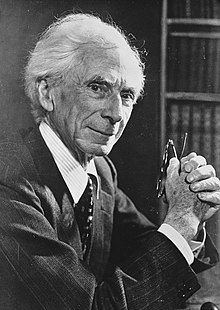
Bertrand Russell cropped.jpg
Why I Am Not A Christian
 by Bertrand Russell
--------------------------------------------------------------------------------
Introductory note: Russell delivered this lecture on March 6, 1927 to the National Secular Society, South London Branch, at Battersea Town Hall. Published in pamphlet form in that same year, the essay subsequently achieved new fame with Paul Edwards' edition of Russell's book, Why I Am Not a Christian and Other Essays ... (1957).
--------------------------------------------------------------------------------
As your Chairman has told you, the subject about which I am going to speak to you tonight is "Why I Am Not a Christian." Perhaps it would be as well, first of all, to try to make out what one means by the word Christian. It is used these days in a very loose sense by a great many people. Some people mean no more by it than a person who attempts to live a good life. In that sense I suppose there would be Christians in all sects and creeds; but I do not think that that is the proper sense of the word, if only because it would imply that all the people who are not Christians -- all the Buddhists, Confucians, Mohammedans, and so on -- are not trying to live a good life. I do not mean by a Christian any person who tries to live decently according to his lights. I think that you must have a certain amount of definite belief before you have a right to call yourself a Christian. The word does not have quite such a full-blooded meaning now as it had in the times of St. Augustine and St. Thomas Aquinas. In those days, if a man said that he was a Christian it was known what he meant. You accepted a whole collection of creeds which were set out with great precision, and every single syllable of those creeds you believed with the whole strength of your convictions.
  

What Is a Christian?
 Nowadays it is not quite that. We have to be a little more vague in our meaning of Christianity. I think, however, that there are two different items which are quite essential to anybody calling himself a Christian. The first is one of a dogmatic nature -- namely, that you must believe in God and immortality. If you do not believe in those two things, I do not think that you can properly call yourself a Christian. Then, further than that, as the name implies, you must have some kind of belief about Christ. The Mohammedans, for instance, also believe in God and in immortality, and yet they would not call themselves Christians. I think you must have at the very lowest the belief that Christ was, if not divine, at least the best and wisest of men. If you are not going to believe that much about Christ, I do not think you have any right to call yourself a Christian. Of course, there is another sense, which you find in Whitaker's Almanack and in geography books, where the population of the world is said to be divided into Christians, Mohammedans, Buddhists, fetish worshipers, and so on; and in that sense we are all Christians. The geography books count us all in, but that is a purely geographical sense, which I suppose we can ignore.Therefore I take it that when I tell you why I am not a Christian I have to tell you two different things: first, why I do not believe in God and in immortality; and, secondly, why I do not think that Christ was the best and wisest of men, although I grant him a very high degree of moral goodness.
  But for the successful efforts of unbelievers in the past, I could not take so elastic a definition of Christianity as that. As I said before, in olden days it had a much more full-blooded sense. For instance, it included he belief in hell. Belief in eternal hell-fire was an essential item of Christian belief until pretty recent times. In this country, as you know, it ceased to be an essential item because of a decision of the Privy Council, and from that decision the Archbishop of Canterbury and the Archbishop of York dissented; but in this country our religion is settled by Act of Parliament, and therefore the Privy Council was able to override their Graces and hell was no longer necessary to a Christian. Consequently I shall not insist that a Christian must believe in hell.
  

The Existence of God
 To come to this question of the existence of God: it is a large and serious question, and if I were to attempt to deal with it in any adequate manner I should have to keep you here until Kingdom Come, so that you will have to excuse me if I deal with it in a somewhat summary fashion. You know, of course, that the Catholic Church has laid it down as a dogma that the existence of God can be proved by the unaided reason. That is a somewhat curious dogma, but it is one of their dogmas. They had to introduce it because at one time the freethinkers adopted the habit of saying that there were such and such arguments which mere reason might urge against the existence of God, but of course they knew as a matter of faith that God did exist. The arguments and the reasons were set out at great length, and the Catholic Church felt that they must stop it. Therefore they laid it down that the existence of God can be proved by the unaided reason and they had to set up what they considered were arguments to prove it. There are, of course, a number of them, but I shall take only a few.
 
The First-cause Argument
 Perhaps the simplest and easiest to understand is the argument of the First Cause. (It is maintained that everything we see in this world has a cause, and as you go back in the chain of causes further and further you must come to a First Cause, and to that First Cause you give the name of God.) That argument, I suppose, does not carry very much weight nowadays, because, in the first place, cause is not quite what it used to be. The philosophers and the men of science have got going on cause, and it has not anything like the vitality it used to have; but, apart from that, you can see that the argument that there must be a First Cause is one that cannot have any validity. I may say that when I was a young man and was debating these questions very seriously in my mind, I for a long time accepted the argument of the First Cause, until one day, at the age of eighteen, I read John Stuart Mill's Autobiography, and I there found this sentence: "My father taught me that the question 'Who made me?' cannot be answered, since it immediately suggests the further question `Who made god?'" That very simple sentence showed me, as I still think, the fallacy in the argument of the First Cause. If everything must have a cause, then God must have a cause. If there can be anything without a cause, it may just as well be the world as God, so that there cannot be any validity in that argument. It is exactly of the same nature as the Hindu's view, that the world rested upon an elephant and the elephant rested upon a tortoise; and when they said, "How about the tortoise?" the Indian said, "Suppose we change the subject." The argument is really no better than that. There is no reason why the world could not have come into being without a cause; nor, on the other hand, is there any reason why it should not have always existed. There is no reason to suppose that the world had a beginning at all. The idea that things must have a beginning is really due to the poverty of our imagination. Therefore, perhaps, I need not waste any more time upon the argument about the First Cause.
 
The Natural-law Argument
 Then there is a very common argument from natural law. That was a favorite argument all through the eighteenth century, especially under the influence of Sir Isaac Newton and his cosmogony. People observed the planets going around the sun according to the law of gravitation, and they thought that God had given a behest to these planets to move in that particular fashion, and that was why they did so. That was, of course, a convenient and simple explanation that saved them the trouble of looking any further for explanations of the law of gravitation. Nowadays we explain the law of gravitation in a somewhat complicated fashion that Einstein has introduced. I do not propose to give you a lecture on the law of gravitation, as interpreted by Einstein, because that again would take some time; at any rate, you no longer have the sort of natural law that you had in the Newtonian system, where, for some reason that nobody could understand, nature behaved in a uniform fashion. We now find that a great many things we thought were natural laws are really human conventions. You know that even in the remotest depths of stellar space there are still three feet to a yard. That is, no doubt, a very remarkable fact, but you would hardly call it a law of nature. And a great many things that have been regarded as laws of nature are of that kind. On the other hand, where you can get down to any knowledge of what atoms actually do, you will find they are much less subject to law than people thought, and that the laws at which you arrive are statistical averages of just the sort that would emerge from chance. There is, as we all know, a law that if you throw dice you will get double sixes only about once in thirty-six times, and we do not regard that as evidence that the fall of the dice is regulated by design; on the contrary, if the double sixes came every time we should think that there was design. The laws of nature are of that sort as regards a great many of them. They are statistical averages such as would emerge from the laws of chance; and that makes this whole business of natural law much less impressive than it formerly was. Quite apart from that, which represents the momentary state of science that may change tomorrow, the whole idea that natural laws imply a lawgiver is due to a confusion between natural and human laws. Human laws are behests commanding you to behave a certain way, in which you may choose to behave, or you may choose not to behave; but natural laws are a description of how things do in fact behave, and being a mere description of what they in fact do, you cannot argue that there must be somebody who told them to do that, because even supposing that there were, you are then faced with the question "Why did God issue just those natural laws and no others?" If you say that he did it simply from his own good pleasure, and without any reason, you then find that there is something which is not subject to law, and so your train of natural law is interrupted. If you say, as more orthodox theologians do, that in all the laws which God issues he had a reason for giving those laws rather than others -- the reason, of course, being to create the best universe, although you would never think it to look at it -- if there were a reason for the laws which God gave, then God himself was subject to law, and therefore you do not get any advantage by introducing God as an intermediary. You really have a law outside and anterior to the divine edicts, and God does not serve your purpose, because he is not the ultimate lawgiver. In short, this whole argument about natural law no longer has anything like the strength that it used to have. I am traveling on in time in my review of the arguments. The arguments that are used for the existence of God change their character as time goes on. They were at first hard intellectual arguments embodying certain quite definite fallacies. As we come to modern times they become less respectable intellectually and more and more affected by a kind of moralizing vagueness.
  
The Argument from Design
 The next step in the process brings us to the argument from design. You all know the argument from design: everything in the world is made just so that we can manage to live in the world, and if the world was ever so little different, we could not manage to live in it. That is the argument from design. It sometimes takes a rather curious form; for instance, it is argued that rabbits have white tails in order to be easy to shoot. I do not know how rabbits would view that application. It is an easy argument to parody. You all know Voltaire's remark, that obviously the nose was designed to be such as to fit spectacles. That sort of parody has turned out to be not nearly so wide of the mark as it might have seemed in the eighteenth century, because since the time of Darwin we understand much better why living creatures are adapted to their environment. It is not that their environment was made to be suitable to them but that they grew to be suitable to it, and that is the basis of adaptation. There is no evidence of design about it.
 When you come to look into this argument from design, it is a most astonishing thing that people can believe that this world, with all the things that are in it, with all its defects, should be the best that omnipotence and omniscience have been able to produce in millions of years. I really cannot believe it. Do you think that, if you were granted omnipotence and omniscience and millions of years in which to perfect your world, you could produce nothing better than the Ku Klux Klan or the Fascists? Moreover, if you accept the ordinary laws of science, you have to suppose that human life and life in general on this planet will die out in due course: it is a stage in the decay of the solar system; at a certain stage of decay you get the sort of conditions of temperature and so forth which are suitable to protoplasm, and there is life for a short time in the life of the whole solar system. You see in the moon the sort of thing to which the earth is tending -- something dead, cold, and lifeless.

 I am told that that sort of view is depressing, and people will sometimes tell you that if they believed that, they would not be able to go on living. Do not believe it; it is all nonsense. Nobody really worries about much about what is going to happen millions of years hence. Even if they think they are worrying much about that, they are really deceiving themselves. They are worried about something much more mundane, or it may merely be a bad digestion; but nobody is really seriously rendered unhappy by the thought of something that is going to happen to this world millions and millions of years hence. Therefore, although it is of course a gloomy view to suppose that life will die out -- at least I suppose we may say so, although sometimes when I contemplate the things that people do with their lives I think it is almost a consolation -- it is not such as to render life miserable. It merely makes you turn your attention to other things.
  

The Moral Arguments for Deity
 Now we reach one stage further in what I shall call the intellectual descent that the Theists have made in their argumentations, and we come to what are called the moral arguments for the existence of God. You all know, of course, that there used to be in the old days three intellectual arguments for the existence of God, all of which were disposed of by Immanuel Kant in the Critique of Pure Reason; but no sooner had he disposed of those arguments than he invented a new one, a moral argument, and that quite convinced him. He was like many people: in intellectual matters he was skeptical, but in moral matters he believed implicitly in the maxims that he had imbibed at his mother's knee. That illustrates what the psychoanalysts so much emphasize -- the immensely stronger hold upon us that our very early associations have than those of later times.
  Kant, as I say, invented a new moral argument for the existence of God, and that in varying forms was extremely popular during the nineteenth century. It has all sorts of forms. One form is to say there would be no right or wrong unless God existed. I am not for the moment concerned with whether there is a difference between right and wrong, or whether there is not: that is another question. The point I am concerned with is that, if you are quite sure there is a difference between right and wrong, then you are in this situation: Is that difference due to God's fiat or is it not? If it is due to God's fiat, then for God himself there is no difference between right and wrong, and it is no longer a significant statement to say that God is good. If you are going to say, as theologians do, that God is good, you must then say that right and wrong have some meaning which is independent of God's fiat, because God's fiats are good and not bad independently of the mere fact that he made them. If you are going to say that, you will then have to say that it is not only through God that right and wrong came into being, but that they are in their essence logically anterior to God. You could, of course, if you liked, say that there was a superior deity who gave orders to the God that made this world, or could take up the line that some of the gnostics took up -- a line which I often thought was a very plausible one -- that as a matter of fact this world that we know was made by the devil at a moment when God was not looking. There is a good deal to be said for that, and I am not concerned to refute it.
  

The Argument for the Remedying of Injustice
 Then there is another very curious form of moral argument, which is this: they say that the existence of God is required in order to bring justice into the world. In the part of this universe that we know there is great injustice, and often the good suffer, and often the wicked prosper, and one hardly knows which of those is the more annoying; but if you are going to have justice in the universe as a whole you have to suppose a future life to redress the balance of life here on earth. So they say that there must be a God, and there must be Heaven and Hell in order that in the long run there may be justice. That is a very curious argument. If you looked at the matter from a scientific point of view, you would say, "After all, I only know this world. I do not know about the rest of the universe, but so far as one can argue at all on probabilities one would say that probably this world is a fair sample, and if there is injustice here the odds are that there is injustice elsewhere also." Supposing you got a crate of oranges that you opened, and you found all the top layer of oranges bad, you would not argue, "The underneath ones must be good, so as to redress the balance." You would say, "Probably the whole lot is a bad consignment"; and that is really what a scientific person would argue about the universe. He would say, "Here we find in this world a great deal of injustice, and so far as that goes that is a reason for supposing that justice does not rule in the world; and therefore so far as it goes it affords a moral argument against deity and not in favor of one." Of course I know that the sort of intellectual arguments that I have been talking to you about are not what really moves people. What really moves people to believe in God is not any intellectual argument at all. Most people believe in God because they have been taught from early infancy to do it, and that is the main reason.
  Then I think that the next most powerful reason is the wish for safety, a sort of feeling that there is a big brother who will look after you. That plays a very profound part in influencing people's desire for a belief in God.
  

The Character of Christ
 I now want to say a few words upon a topic which I often think is not quite sufficiently dealt with by Rationalists, and that is the question whether Christ was the best and the wisest of men. It is generally taken for granted that we should all agree that that was so. I do not myself. I think that there are a good many points upon which I agree with Christ a great deal more than the professing Christians do. I do not know that I could go with Him all the way, but I could go with Him much further than most professing Christians can. You will remember that He said, "Resist not evil: but whosoever shall smite thee on thy right cheek, turn to him the other also." That is not a new precept or a new principle. It was used by Lao-tse and Buddha some 500 or 600 years before Christ, but it is not a principle which as a matter of fact Christians accept. I have no doubt that the present prime minister [Stanley Baldwin], for instance, is a most sincere Christian, but I should not advise any of you to go and smite him on one cheek. I think you might find that he thought this text was intended in a figurative sense.
  Then there is another point which I consider excellent. You will remember that Christ said, "Judge not lest ye be judged." That principle I do not think you would find was popular in the law courts of Christian countries. I have known in my time quite a number of judges who were very earnest Christians, and none of them felt that they were acting contrary to Christian principles in what they did. Then Christ says, "Give to him that asketh of thee, and from him that would borrow of thee turn not thou away." That is a very good principle. Your Chairman has reminded you that we are not here to talk politics, but I cannot help observing that the last general election was fought on the question of how desirable it was to turn away from him that would borrow of thee, so that one must assume that the Liberals and Conservatives of this country are composed of people who do not agree with the teaching of Christ, because they certainly did very emphatically turn away on that occasion.

 Then there is one other maxim of Christ which I think has a great deal in it, but I do not find that it is very popular among some of our Christian friends. He says, "If thou wilt be perfect, go and sell that which thou hast, and give to the poor." That is a very excellent maxim, but, as I say, it is not much practised. All these, I think, are good maxims, although they are a little difficult to live up to. I do not profess to live up to them myself; but then, after all, it is not quite the same thing as for a Christian.
  

Defects in Christ's Teaching
 Having granted the excellence of these maxims, I come to certain points in which I do not believe that one can grant either the superlative wisdom or the superlative goodness of Christ as depicted in the Gospels; and here I may say that one is not concerned with the historical question. Historically it is quite doubtful whether Christ ever existed at all, and if He did we do not know anything about him, so that I am not concerned with the historical question, which is a very difficult one. I am concerned with Christ as He appears in the Gospels, taking the Gospel narrative as it stands, and there one does find some things that do not seem to be very wise. For one thing, he certainly thought that His second coming would occur in clouds of glory before the death of all the people who were living at that time. There are a great many texts that prove that. He says, for instance, "Ye shall not have gone over the cities of Israel till the Son of Man be come." Then he says, "There are some standing here which shall not taste death till the Son of Man comes into His kingdom"; and there are a lot of places where it is quite clear that He believed that His second coming would happen during the lifetime of many then living. That was the belief of His earlier followers, and it was the basis of a good deal of His moral teaching. When He said, "Take no thought for the morrow," and things of that sort, it was very largely because He thought that the second coming was going to be very soon, and that all ordinary mundane affairs did not count. I have, as a matter of fact, known some Christians who did believe that the second coming was imminent. I knew a parson who frightened his congregation terribly by telling them that the second coming was very imminent indeed, but they were much consoled when they found that he was planting trees in his garden. The early Christians did really believe it, and they did abstain from such things as planting trees in their gardens, because they did accept from Christ the belief that the second coming was imminent. In that respect, clearly He was not so wise as some other people have been, and He was certainly not superlatively wise.
  
The Moral Problem
 Then you come to moral questions. There is one very serious defect to my mind in Christ's moral character, and that is that He believed in hell. I do not myself feel that any person who is really profoundly humane can believe in everlasting punishment. Christ certainly as depicted in the Gospels did believe in everlasting punishment, and one does find repeatedly a vindictive fury against those people who would not listen to His preaching -- an attitude which is not uncommon with preachers, but which does somewhat detract from superlative excellence. You do not, for instance find that attitude in Socrates. You find him quite bland and urbane toward the people who would not listen to him; and it is, to my mind, far more worthy of a sage to take that line than to take the line of indignation. You probably all remember the sorts of things that Socrates was saying when he was dying, and the sort of things that he generally did say to people who did not agree with him.
  You will find that in the Gospels Christ said, "Ye serpents, ye generation of vipers, how can ye escape the damnation of Hell." That was said to people who did not like His preaching. It is not really to my mind quite the best tone, and there are a great many of these things about Hell. There is, of course, the familiar text about the sin against the Holy Ghost: "Whosoever speaketh against the Holy Ghost it shall not be forgiven him neither in this World nor in the world to come." That text has caused an unspeakable amount of misery in the world, for all sorts of people have imagined that they have committed the sin against the Holy Ghost, and thought that it would not be forgiven them either in this world or in the world to come. I really do not think that a person with a proper degree of kindliness in his nature would have put fears and terrors of that sort into the world.

 Then Christ says, "The Son of Man shall send forth his His angels, and they shall gather out of His kingdom all things that offend, and them which do iniquity, and shall cast them into a furnace of fire; there shall be wailing and gnashing of teeth"; and He goes on about the wailing and gnashing of teeth. It comes in one verse after another, and it is quite manifest to the reader that there is a certain pleasure in contemplating wailing and gnashing of teeth, or else it would not occur so often. Then you all, of course, remember about the sheep and the goats; how at the second coming He is going to divide the sheep from the goats, and He is going to say to the goats, "Depart from me, ye cursed, into everlasting fire." He continues, "And these shall go away into everlasting fire." Then He says again, "If thy hand offend thee, cut it off; it is better for thee to enter into life maimed, than having two hands to go into Hell, into the fire that never shall be quenched; where the worm dieth not and the fire is not quenched." He repeats that again and again also. I must say that I think all this doctrine, that hell-fire is a punishment for sin, is a doctrine of cruelty. It is a doctrine that put cruelty into the world and gave the world generations of cruel torture; and the Christ of the Gospels, if you could take Him asHis chroniclers represent Him, would certainly have to be considered partly responsible for that.

 There are other things of less importance. There is the instance of the Gadarene swine, where it certainly was not very kind to the pigs to put the devils into them and make them rush down the hill into the sea. You must remember that He was omnipotent, and He could have made the devils simply go away; but He chose to send them into the pigs. Then there is the curious story of the fig tree, which always rather puzzled me. You remember what happened about the fig tree. "He was hungry; and seeing a fig tree afar off having leaves, He came if haply He might find anything thereon; and when He came to it He found nothing but leaves, for the time of figs was not yet. And Jesus answered and said unto it: 'No man eat fruit of thee hereafter for ever' . . . and Peter . . . saith unto Him: 'Master, behold the fig tree which thou cursedst is withered away.'" This is a very curious story, because it was not the right time of year for figs, and you really could not blame the tree. I cannot myself feel that either in the matter of wisdom or in the matter of virtue Christ stands quite as high as some other people known to history. I think I should put Buddha and Socrates above Him in those respects.
  

The Emotional Factor
 As I said before, I do not think that the real reason why people accept religion has anything to do with argumentation. They accept religion on emotional grounds. One is often told that it is a very wrong thing to attack religion, because religion makes men virtuous. So I am told; I have not noticed it. You know, of course, the parody of that argument in Samuel Butler's book, Erewhon Revisited. You will remember that in Erewhon there is a certain Higgs who arrives in a remote country, and after spending some time there he escapes from that country in a balloon. Twenty years later he comes back to that country and finds a new religion in which he is worshiped under the name of the "Sun Child," and it is said that he ascended into heaven. He finds that the Feast of the Ascension is about to be celebrated, and he hears Professors Hanky and Panky say to each other that they never set eyes on the man Higgs, and they hope they never will; but they are the high priests of the religion of the Sun Child. He is very indignant, and he comes up to them, and he says, "I am going to expose all this humbug and tell the people of Erewhon that it was only I, the man Higgs, and I went up in a balloon." He was told, "You must not do that, because all the morals of this country are bound round this myth, and if they once know that you did not ascend into Heaven they will all become wicked"; and so he is persuaded of that and he goes quietly away.
  That is the idea -- that we should all be wicked if we did not hold to the Christian religion. It seems to me that the people who have held to it have been for the most part extremely wicked. You find this curious fact, that the more intense has been the religion of any period and the more profound has been the dogmatic belief, the greater has been the cruelty and the worse has been the state of affairs. In the so-called ages of faith, when men really did believe the Christian religion in all its completeness, there was the Inquisition, with all its tortures; there were millions of unfortunate women burned as witches; and there was every kind of cruelty practiced upon all sorts of people in the name of religion.

 You find as you look around the world that every single bit of progress in humane feeling, every improvement in the criminal law, every step toward the diminution of war, every step toward better treatment of the colored races, or every mitigation of slavery, every moral progress that there has been in the world, has been consistently opposed by the organized churches of the world. I say quite deliberately that the Christian religion, as organized in its churches, has been and still is the principal enemy of moral progress in the world.
  

How the Churches Have Retarded Progress
 You may think that I am going too far when I say that that is still so. I do not think that I am. Take one fact. You will bear with me if I mention it. It is not a pleasant fact, but the churches compel one to mention facts that are not pleasant. Supposing that in this world that we live in today an inexperienced girl is married to a syphilitic man; in that case the Catholic Church says, "This is an indissoluble sacrament. You must endure celibacy or stay together. And if you stay together, you must not use birth control to prevent the birth of syphilitic children." Nobody whose natural sympathies have not been warped by dogma, or whose moral nature was not absolutely dead to all sense of suffering, could maintain that it is right and proper that that state of things should continue.
  That is only an example. There are a great many ways in which, at the present moment, the church, by its insistence upon what it chooses to call morality, inflicts upon all sorts of people undeserved and unnecessary suffering. And of course, as we know, it is in its major part an opponent still of progress and improvement in all the ways that diminish suffering in the world, because it has chosen to label as morality a certain narrow set of rules of conduct which have nothing to do with human happiness; and when you say that this or that ought to be done because it would make for human happiness, they think that has nothing to do with the matter at all. "What has human happiness to do with morals? The object of morals is not to make people happy."
  

Fear, the Foundation of Religion
 Religion is based, I think, primarily and mainly upon fear. It is partly the terror of the unknown and partly, as I have said, the wish to feel that you have a kind of elder brother who will stand by you in all your troubles and disputes. Fear is the basis of the whole thing -- fear of the mysterious, fear of defeat, fear of death. Fear is the parent of cruelty, and therefore it is no wonder if cruelty and religion have gone hand in hand. It is because fear is at the basis of those two things. In this world we can now begin a little to understand things, and a little to master them by help of science, which has forced its way step by step against the Christian religion, against the churches, and against the opposition of all the old precepts. Science can help us to get over this craven fear in which mankind has lived for so many generations. Science can teach us, and I think our own hearts can teach us, no longer to look around for imaginary supports, no longer to invent allies in the sky, but rather to look to our own efforts here below to make this world a better place to live in, instead of the sort of place that the churches in all these centuries have made it.
  
What We Must Do
 We want to stand upon our own feet and look fair and square at the world -- its good facts, its bad facts, its beauties, and its ugliness; see the world as it is and be not afraid of it. Conquer the world by intelligence and not merely by being slavishly subdued by the terror that comes from it. The whole conception of God is a conception derived from the ancient Oriental despotisms. It is a conception quite unworthy of free men. When you hear people in church debasing themselves and saying that they are miserable sinners, and all the rest of it, it seems contemptible and not worthy of self-respecting human beings. We ought to stand up and look the world frankly in the face. We ought to make the best we can of the world, and if it is not so good as we wish, after all it will still be better than what these others have made of it in all these ages. A good world needs knowledge, kindliness, and courage; it does not need a regretful hankering after the past or a fettering of the free intelligence by the words uttered long ago by ignorant men. It needs a fearless outlook and a free intelligence. It needs hope for the future, not looking back all the time toward a past that is dead, which we trust will be far surpassed by the future that our intelligence can create.

sábado, 9 de febrero de 2013

Ciencia y Religión - Albert Einstein

 Albert Einstein Head.jpg

Science and Religion
By Albert Einstein
--------------------------------------------------------------------------------
This article is taken from:
Science, Philosophy and Religion, A Symposium,
The Conference on Science, Philosophy and Religion
in Their Relation to the Democratic Way of Life, Inc.,
New York, 1941.
--------------------------------------------------------------------------------
It would not be difficult to come to an agreement as to what we understand by science. Science is the century-old endeavor to bring together by means of systematic thought the perceptible phenomena of this world into as thoroughgoing an association as possible. To put it boldly, it is the attempt at the posterior reconstruction of existence by the process of conceptualization. But when asking myself what religion is I cannot think of the answer so easily. And even after finding an answer which may satisfy me at this particular moment, I still remain convinced that I can never under any circumstances bring together, even to a slight extent, the thoughts of all those who have given this question serious consideration.
At first, then, instead of asking what religion is I should prefer to ask what characterizes the aspirations of a person who gives me the impression of being religious: a person who is religiously enlightened appears to me to be one who has, to the best of his ability, liberated himself from the fetters of his selfish desires and is preoccupied with thoughts, feelings, and aspirations to which he clings because of their superpersonalvalue. It seems to me that what is important is the force of this superpersonal content and the depth of the conviction concerning its overpowering meaningfulness, regardless of whether any attempt is made to unite this content with a divine Being, for otherwise it would not be possible to count Buddha and Spinoza as religious personalities. Accordingly, a religious person is devout in the sense that he has no doubt of the significance and loftiness of those superpersonal objects and goals which neither require nor are capable of rational foundation. They exist with the same necessity and matter-of-factness as he himself. In this sense religion is the age-old endeavor of mankind to become clearly and completely conscious of these values and goals and constantly to strengthen and extend their effect. If one conceives of religion and science according to these definitions then a conflict between them appears impossible. For science can only ascertain what is, but not what should be, and outside of its domain value judgments of all kinds remain necessary. Religion, on the other hand, deals only with evaluations of human thought and action: it cannot justifiably speak of facts and relationships between facts. According to this interpretation the well-known conflicts between religion and science in the past must all be ascribed to a misapprehension of the situation which has been described.
For example, a conflict arises when a religious community insists on the absolute truthfulness of all statements recorded in the Bible. This means an intervention on the part of religion into the sphere of science; this is where the struggle of the Church against the doctrines of Galileo and Darwin belongs. On the other hand, representatives of science have often made an attempt to arrive at fundamental judgments with respect to values and ends on the basis of scientific method, and in this way have set themselves in opposition to religion. These conflicts have all sprung from fatal errors.
Now, even though the realms of religion and science in themselves are clearly marked off from each other, nevertheless there exist between the two strong reciprocal relationships and dependencies. Though religion may be that which determines the goal, it has, nevertheless, learned from science, in the broadest sense, what means will contribute to the attainment of the goals it has set up. But science can only be created by those who are thoroughly imbued with the aspiration toward truth and understanding. This source of feeling, however, springs from the sphere of religion. To this there also belongs the faith in the possibility that the regulations valid for the world of existence are rational, that is, comprehensible to reason. I cannot conceive of a genuine scientist without that profound faith. The situation may be expressed by an image: science without religion is lame, religion without science is blind.
Though I have asserted above that in truth a legitimate conflict between religion and science cannot exist, I must nevertheless qualify this assertion once again on an essential point, with reference to the actual content of historical religions. This qualification has to do with the concept of God. During the youthful period of mankind's spiritual evolution human fantasy created gods in man's own image, who, by the operations of their will were supposed to determine, or at any rate to influence, the phenomenal world. Man sought to alter the disposition of these gods in his own favor by means of magic and prayer. The idea of God in the religions taught at present is a sublimation of that old concept of the gods. Its anthropomorphic character is shown, for instance, by the fact that men appeal to the Divine Being in prayers and plead for the fulfillment of their wishes.
Nobody, certainly, will deny that the idea of the existence of an omnipotent, just, and omnibeneficent personal God is able to accord man solace, help, and guidance; also, by virtue of its simplicity it is accessible to the most undeveloped mind. But, on the other hand, there are decisive weaknesses attached to this idea in itself, which have been painfully felt since the beginning of history. That is, if this being is omnipotent, then every occurrence, including every human action, every human thought, and every human feeling and aspiration is also His work; how is it possible to think of holding men responsible for their deeds and thoughts before such an almighty Being? In giving out punishment and rewards He would to a certain extent be passing judgment on Himself. How can this be combined with the goodness and righteousness ascribed to Him?
The main source of the present-day conflicts between the spheres of religion and of science lies in this concept of a personal God. It is the aim of science to establish general rules which determine the reciprocal connection of objects and events in time and space. For these rules, or laws of nature, absolutely general validity is required--not proven. It is mainly a program, and faith in the possibility of its accomplishment in principle is only founded on partial successes. But hardly anyone could be found who would deny these partial successes and ascribe them to human self-deception. The fact that on the basis of such laws we are able to predict the temporal behavior of phenomena in certain domains with great precision and certainty is deeply embedded in the consciousness of the modern man, even though he may have grasped very little of the contents of those laws. He need only consider that planetary courses within the solar system may be calculated in advance with great exactitude on the basis of a limited number of simple laws. In a similar way, though not with the same precision, it is possible to calculate in advance the mode of operation of an electric motor, a transmission system, or of a wireless apparatus, even when dealing with a novel development.
To be sure, when the number of factors coming into play in a phenomenological complex is too large, scientific method in most cases fails us. One need only think of the weather, in which case prediction even for a few days ahead is impossible. Nevertheless no one doubts that we are confronted with a causal connection whose causal components are in the main known to us. Occurrences in this domain are beyond the reach of exact prediction because of the variety of factors in operation, not because of any lack of order in nature.
We have penetrated far less deeply into the regularities obtaining within the realm of living things, but deeply enough nevertheless to sense at least the rule of fixed necessity. One need only think of the systematic order in heredity, and in the effect of poisons, as for instance alcohol, on the behavior of organic beings. What is still lacking here is a grasp of connections of profound generality, but not a knowledge of order in itself.
The more a man is imbued with the ordered regularity of all events the firmer becomes his conviction that there is no room left by the side of this ordered regularity for causes of a different nature. For him neither the rule of human nor the rule of divine will exists as an independent cause of natural events. To be sure, the doctrine of a personal God interfering with natural events could never be refuted, in the real sense, by science, for this doctrine can always take refuge in those domains in which scientific knowledge has not yet been able to set foot.
But I am persuaded that such behavior on the part of the representatives of religion would not only be unworthy but also fatal. For a doctrine which is able to maintain itself not in clear light but only in the dark, will of necessity lose its effect on mankind, with incalculable harm to human progress. In their struggle for the ethical good, teachers of religion must have the stature to give up the doctrine of a personal God, that is, give up that source of fear and hope which in the past placed such vast power in the hands of priests. In their labors they will have to avail themselves of those forces which are capable of cultivating the Good, the True, and the Beautiful in humanity itself. This is, to be sure, a more difficult but an incomparably more worthy task. (This thought is convincingly presented in Herbert Samuel's book, Belief and Action.) After religious teachers accomplish the refining process indicated they will surely recognize with joy that true religion has been ennobled and made more profound by scientific knowledge.
If it is one of the goals of religion to liberate mankind as far as possible from the bondage of egocentric cravings, desires, and fears, scientific reasoning can aid religion in yet another sense. Although it is true that it is the goal of science to discover rules which permit the association and foretelling of facts, this is not its only aim. It also seeks to reduce the connections discovered to the smallest possible number of mutually independent conceptual elements. It is in this striving after the rational unification of the manifold that it encounters its greatest successes, even though it is precisely this attempt which causes it to run the greatest risk of falling a prey to illusions. But whoever has undergone the intense experience of successful advances made in this domain is moved by profound reverence for the rationality made manifest in existence. By way of the understanding he achieves a far-reaching emancipation from the shackles of personal hopes and desires, and thereby attains that humble attitude of mind toward the grandeur of reason incarnate in existence, and which, in its profoundest depths, is inaccessible to man. This attitude, however, appears to me to be religious, in the highest sense of the word. And so it seems to me that science not only purifies the religious impulse of the dross of its anthropomorphism but also contributes to a religious spiritualization of our understanding of life.
The further the spiritual evolution of mankind advances, the more certain it seems to me that the path to genuine religiosity does not lie through the fear of life, and the fear of death, and blind faith, but through striving after rational knowledge. In this sense I believe that the priest must become a teacher if he wishes to do justice to his lofty educational mission.

domingo, 18 de noviembre de 2012

Los "Bobones"


Esto contiene una imagen de: 

 Infanta elena y jaime de marichalar bautizo de su hijo

 Esto contiene una imagen de:

 La realeza española asistió a la 28ª recepción de los Premios Princesa de Asturias en la Plaza de la Catedral

Los "Bobones"

 En un anciano país
 existió una monarquía
 que comenzó en democracia
 y terminó en anarquía.
 En aquel reino reinaba
 una curiosa familia:
 un "Bobón" de nuevo cuño
 y una griega algo engreída
 que engendraron dos princesas
 y un príncipe en demasía
 por cumplir con la ley Sálica
 que consagraba la hombría.
 La cosa empezó a torcerse
 con las bodas de las hijas,
 algo ligeras de cascos
 y de moral distraída.
 La mayor, que era algo lela,
 pasó por la vicaría
 con un noble también lelo
 en la ciudad de Sevilla.
 Al poco tiempo parió
 un querubín de revista
 que devino en gamberrete
 con escasa puntería.
 La segunda, buena jaca,
 se cameló a un deportista,
 que dejó a su antigua novia
 y se encoñó con la niña.
 De jaca pasó a coneja
 y cada año paría
 "urdangarines" de pro,
 chupones de dinastía.
 Y el principito heredero,
 cortejador de coristas,
 cayó por fin en el cebo
 de una artera periodista,
 divorciada y con más mañas
 que la puta Celestina;
 pero falló en la preñez
 por seguir la dinastía
 pues en lugar de un varón
 paría niña tras niña.
 Pero empiezan los problemas
 y la cosa se complica
 por culpa de estos gañanes
 que, de nobleza, ni pizca.
 El noble rancio de Soria,
 bermudas y en zapatillas,
 paseaba por Serrano
 cual jocunda modistilla;
 circulaba en patinete
 con ignorante osadía
 saltándose a la torera
 direcciones prohibidas
 Y el "Bobón" mandó parar,
 se acabó la algarabía,
 suspendió la convivencia
 y se cargó una familia.
 El chico del balonmano,
 modelo de deportistas,
 se convirtió en un truhán,
 en un vulgar chantajista
 que, siendo duque de Palma,
 tuvo la necia osadía
 de estafar unos millones
 en tan reputada isla.
 Y el "Bobón" mandó parar,
 porque al duque sugería
 que se marchase del reino
 a ocultar sus fechorías.
 La justicia que no es lerda,
 apeló a su señoría,
 y es fácil que al señorito
 le caigan ciento y un días.
 El príncipe mientras tanto
 afronta esta travesía
 sin saber que el gran patrón
 prepara una felonía.
 Sin encomendarse a nadie
 se ha ido de cacería
 a la sabana africana,
 solito y sin la Sofía ,
 sabiendo que a la llegada
 le esperaba mis Corina,
 rubia y jacarandosa,
 cortesana la más fina.
 A la mañana siguiente
 salieron de cacería,
 cacería de elefantes,
 que es una cosa muy fina.
 Parece ser que cobraron
 colmillos de gran valía,
 y a celebrarlo montaron
 una generosa orgía.
 El "Bobón" de las narices
 como un cosaco bebía,
 y apañó tan regia trompa
 que salió con alegría
 no a por rudos elefantes
 sino a trincarse a Corina
 que lo esperaba anhelante
 tras las leves celosías
 del bungalow colindante.
 Como al pendejo le ardía
 la cosa entre la entrepierna,
 pensando que ya subía
 al catre de aquella fiera,
 aceleró por la prisa
 y tropezó en un tablón
 y tropezó de tal guisa
 que se crujió la cadera
 y se le aflojó la picha.
 Al monarca, trastornado,
 llevan a la enfermería,
 y al ver que es cosa muy seria
 llaman a Cancillería
 para repatriar al bobo
 y salvar la Monarquía.
 Corina, desconsolada,
 triste, sola y compungida,
 se consoló con un negro,
 muy bien armado y sin prisas.
 Mientras, la consorte griega
 celebra Pascua Florida
 blasfemando porque el Rey
 la cuernea con Corina.
 Esta es la historia,señores,
 del reino de Picardía,
 donde los nobles y reyes
 ejercen con alegría
 un papel desvergonzado,
 las más torpes tropelías,
 mientras el pueblo se jode
 y no le encuentra salida
 a los más duros problemas
 de su aperreada vida.

martes, 23 de octubre de 2012

Las ilusiones perdidas


No se van en trenes con maletas de cartón pero llevan sus bienes más preciados: un portátil, un móvil de última generación regalado por un familiar o conseguido a base de una lucha de puntos sin cuartel. Suelen tomar un vuelo de bajo coste, cazado pacientemente en las redes de Internet. Se van a hacer un máster, o han logrado una mal llamada beca Erasmus que costará a la familia la mitad de sus ahorros. Otras veces van a hacer de au-pair, de auxiliar de conversación, o a cualquier trabajo temporal. La familia va a despedirlos a la puerta de embarque y mientras se alejan disimularán unos su pena y otros su incipiente desamparo. "Es por poco tiempo -se dicen-. Dominarán el idioma, conocerán mundo... Regresarán en pocos meses".

Hasta hace poco era un privilegio de los nuevos tiempos que les permitía gozar de una libertad sin límites, de un mundo sin fronteras, de una capacidad casi infinita de aprendizaje... Hasta que llegó la crisis y la maleta pareció distinta, la espera en la fila de embarque más embarazosa, la despedida más triste y el fantasma de la ausencia definitiva más cercano.

No. No llevan maletas de cartón, ni hay aglomeraciones en el andén de la despedida. No se marchan en grupo, sino uno a uno. Aparentemente nada les obliga. Ha sido una cadena invisible de acontecimientos. Estuvieron allí hace unos años, o tienen una amiga que les ha informado de que puede encontrar algún trabajo con facilidad. No pagarán mucho, eso es seguro, pero podrán ganarse la vida con cierta facilidad... A fin de cuentas aquí no hay nada.

Y se marchan poco a poco, sin alboroto alguno. Un goteo incesante de savia nueva que sale sin ruido de nuestro país, desmintiendo la vieja quimera de que la historia es un caudal continuo de mejoras.


No hay estadísticas oficiales sobre ellos. Nadie sabe cuántos son ni adonde se dirigen. No se agrupan bajo el nombre oficial de emigrantes. Son, más bien, una microhistoria que se cuenta entre amigos y familiares. "Mi hija está en Berlín", "se ha marchado a Montpellier", "se fue a Dubai" son frases que escuchamos sin reparar en el significado exacto que comportan. Escapan a las estadísticas de la emigración porque suelen tener un nivel alto de estudios y no se corresponden con el perfil típico de lo que pensamos que es un emigrante. Quizá en las cuentas oficiales figuren como residentes en el extranjero, pero deberían aparecer como nuevos exiliados producto de la ceguera de nuestro país.

En los tiempos de crisis que detallan cada euro gastado nadie computa los centenares de miles de euros empleados en su formación y regalados a empresarios de más allá de nuestras fronteras con una torpeza sin límites, con una ignorancia sin parangón. Menos aún se cuantifican el esfuerzo de sus familias, las ilusiones perdidas y sus sueños rotos en mil pedazos.

No llevan maletas de cartón, pero componen un nuevo éxodo que azota especialmente a Andalucía, que dispersa a nuestros jóvenes por toda Europa y gran parte del mundo, que nos priva de su saber, de su aportación y de su compañía. Pero, aparentemente nadie se escandaliza por esta fuga de cerebros, lenta pero inexorable, que nos privará de muchos de nuestros mejores talentos. Nadie protesta por esta nueva oleada de exiliados que son una acusación silenciosa del fracaso y de engaño. Se van en silencio por el túnel de embarque en el que les alcanzará la melancolía por la pérdida temprana de su tierra.

No son, como dicen, una generación perdida para ellos mismos. No son los socorridos ni-nis que sirven para culpar a la juventud de su falta de empleo. Son una generación perdida para nuestro país y para nuestro futuro. Un tremendo error que pagaremos muy caro en forma de atraso, de empobrecimiento intelectual y técnico. Aunque todavía no lo sepamos.

sábado, 28 de julio de 2012

Las grandes fortunas que no pagan impuestos


                           LA BANCA, EL FRAUDE FISCAL Y EL NEW YORK TIMES.


      El New York Times ha ido publicando una serie de artículos sobre Emilio Botín, presentado por tal rotativo como el banquero más influyente de España, y Presidente del Banco de Santander, que tienen inversiones financieras de gran peso en Brasil, en Gran Bretaña y en Estados Unidos,además de en España.En EE.UU. el Banco de Santander es propietario de Sovereign Bank.

     Lo que le interesa al rotativo estadounidense no es, sin embargo, el comportamiento bancario del Santander, sino el de su Presidente y el de su familia, así como su enorme influencia política y mediática en España. Un indicador de esto último es que ninguno de los cinco rotativos más importantes del país ha citado o hecho comentarios sobre esta serie de artículos en el diario más influyente de EE.UU. y uno de los más influyentes del mundo. Es de suponer que si se escribieran artículos semejantes, por ejemplo, sobre el expresidente Zapatero, tales reportajes serían noticia. No así en el caso Emilio Botín.

     Una discusión importante de tales artículos es el ocultamiento por parte de Emilio Botín y de su familia de unas cuentas secretas establecidas desde la Guerra Civil en la banca suiza HSBC. Por lo visto, en las cuentas de tal banco había 2.000 millones de euros que nunca se habían declarado a las autoridades tributarias del Estado español. Pero,un empleado de tal banco suizo, despechado por el maltrato recibido por tal banco, decidió publicar los nombres de las personas que depositaban su dinero en dicha banca suiza, sin nunca declararlo en sus propios países. Entre ellos había nada menos que 569 españoles, incluyendo a Emilio Botín y su familia, con grandes nombres de la vida política y empresarial (entre ellos, por cierto, el padre del President de la Generalitat, el Sr. Artur Mas; José María Aznar; Dolores Cospedal;Rodrigo Rato; Narcís Serra; Eduardo Zaplana; Miguel Boyer; José Folgado; Carlos Solchaga; Josep Piqué; Rafael Arias-Salgado; Pío Cabanillas; Isabel Tocino; Jordi Sevilla; Josu Jon Imaz; José María Michavila; Juan Miguel Villar Mir; Anna Birulés; Abel Matutes; Julián García Vargas; Ángel Acebes; Eduardo Serra; Marcelino Oreja...). Según el New York Times, esta práctica es muy común entre las grandes familias, las grandes empresas y la gran banca. El fraude fiscal en estos sectores es enorme. Según la propia Agencia Tributaria española, el 74% del fraude fiscal se centra en estos grupos, con un total de 44.000 millones de euros que el Estado español (incluido el central y los autonómicos) no ingresa. Esta cantidad, por cierto, casi alcanza la cifra del déficit de gasto público social de España respecto la media de la UE-15 (66.000 millones de euros), es decir, el gasto que España debería gastarse en su Estado del Bienestar (sanidad, educación, escuelas de infancia, servicios a personas con dependencia, y otros) por el nivel de desarrollo económico que tiene y que no se gasta porque el Estado no recoge tales fondos. Y una de las causas de que no se recojan es precisamente el fraude fiscal realizado por estos colectivos citados en el New York Times. El resultado de su influencia es que el Estado no se atreve a recogerlos. En realidad, la gran mayoría de investigaciones de fraude fiscal de la Agencia Tributaria se centra en los autónomos y profesionales liberales, cuyo fraude fiscal representa -según los técnicos de la Agencia Tributaria del Estado español- sólo el 8% del fraude fiscal total. Es también conocida la intervención de autoridades públicas para proteger al Sr. Emilio Botín de las pesquisas de la propia Agencia Tributaria. El caso más conocido es la gestión realizada por la exVicepresidenta del Gobierno español, la Sra. De la Vega, para interrumpir una de tales investigaciones. Pero el Sr. Botín no es el único. Como señala el New York Times, hace dos años, César Alierta, presidente de Telefónica, que estaba siendo investigado, dejó de estarlo. Como escribe el New York Times con cierta ironía, "el Tribunal desistió de continuar estudiando el caso porque, según el juez, ya había pasado demasiado tiempo entre el momento de los hechos y su presentación al tribunal". Una medida que juega a favor de los fraudulentos es la ineficacia del Estado así como su temor a realizar la investigación. Fue nada menos que el Presidente del Gobierno español, el Sr. José Mª Aznar, que en un momento de franqueza admitió que "los ricos no pagan impuestos en España". Tal tolerancia por parte del Estado con el fraude fiscal de los súperricos se justifica con el argumento de que, aún cuando no pagan impuestos, las consecuencias de ello son limitadas porque son pocos. El Presidente de la Generalitat de Catalunya, el Sr. Artur Mas, ha indicado que la subida de impuestos de los ricos y súper ricos tiene más un valor testimonial que práctico, pues su número es escaso. La solidez de tal argumento, sin embargo, es nula. En realidad, alcanza niveles de frivolidad. Ignora la enorme concentración de las rentas y de la propiedad existente en España (y en Catalunya), uno de los países donde las desigualdades sociales son mayores y el impacto redistributivo del Estado es menor. Los 44.000 millones de euros al año que no se recaudan de los súper ricos por parte del Estado hubieran evitado los enormes recortes de gasto público social que el Estado español está hoy realizando. Pero otra observación que hace el New York Times sobre el fraude fiscal y la banca es el silencio que existe en los medios de información sobre tal fraude fiscal. Tal rotativo cita a Salvador Arancibia, un periodista de temas financieros en Madrid, que trabajó para el Banco Santander, queseñala como causas de este silencio el hecho de que el Banco Santander gasta mucho dinero en anuncios comerciales, siendo la banca uno de los sectores más importantes en la financiación de los medios, no sólo comprando espacio de anuncios comerciales, sino también proveyendo créditos -aclara el Sr. Salvador Arancibia- "...medidas de enorme importancia en un momento como el actual, donde los medios están en una situación financiera muy delicada". De ahí que tenga que agradecer al diario que se atreva a publicarlo, porque hoy, artículos como los que publica el New York Times y el mío propio, no tienen fácil publicación en nuestro país. Es lo que llaman "libertad de prensa".

 Vicenç Navarro, Catedrático de Políticas Públicas de la Universidad Pompeu Fabra y Profesor de Public Policy. The Johns Hopkins University

jueves, 26 de julio de 2012

Exigir la suspensión de las CC.AA.

Carta a la Sra. Merkel:
Exija el fin de las autonomías

Respetada Canciller Federal:
Hace tres semanas, el profesor e historiador norteamericano David
Spengler publicaría una carta abierta en The Asian Times dirigida a su
persona, en la que la pedía “que dejara caer a España”, y explicaba
las razones, que iban desde la incompetencia, el despilfarro y la
corrupción generalizadas del Gobierno y particularmente de las
administraciones territoriales, donde nadie controla nada y nadie
responde de nada, lo que implica una asignación del grueso de los
recursos públicos (45 % del PIB) en forma tan disparatada e ineficaz
que supera todo lo imaginable. Adicionalmente, según el Dr. Spengler,
el Gobierno miente en todo: sobre su situación económica, sobre la
bancaria y sobre la fiscal. Su deuda y los intereses son ya
inasumibles y, en consecuencia, somos insalvables.
No obstante, y aun reconociendo la veracidad de sus afirmaciones -que
tengamos hoy más PIB real que en 2007 resume la falsedad inaudita de
las cifras oficiales-, España no sólo es salvable es que ni siquiera
necesitaría la intervención, sólo necesita la supresión del sistema
autonómico, que representa un despilfarro anual de más de 120.000
millones de euros, equivalentes al 12% del PIB. Sin embargo, la
oligarquía política se opone radicalmente a desmontar esta gigantesca
estructura que ha levantado en su exclusivo beneficio y escapa a las
manos de los españoles el poder de cambiar este expolio de
proporciones épicas. A día de hoy, el déficit de las regiones y
ayuntamientos asciende a unos 5.000 millones de euros mensuales, y
está siendo cubierto por el Gobierno con supuestos “adelantos
presupuestarios”, supuestos porque jamás serán devueltos, lo que ha
elevado el déficit del Estado en un 50% hasta abril, equivalente al
10% del PIB en términos anualizados. Y tampoco pueden pagar los
vencimientos de deuda, más de 25.000 millones, y esperan que el
Gobierno con el dinero del BCE lo haga por ellos.
Con una deuda pública total -no solo la computable- del 118 % del PIB
oficial, un déficit 2012 estimado en más de 110.000 millones y unos
intereses del 4,5% del PIB oficial en los próximos 12 meses, España ha
superado el punto de no retorno y ocurre que sólo Ud. como Canciller
de Alemania y líder más cualificada de Occidente tiene el poder de
acabar con una situación que supondrá la ruina, no solo de España sino
tal vez el fin de la zona euro. Y para evitarlo bastaría exigir,
condicionando a ello cualquier ayuda, la reforma radical de las
instituciones territoriales responsables de los dos tercios del gasto
público. Es absolutamente inaceptable, tanto social como
económicamente, que la UE y el FMI exijan a España que suba impuestos
y recorte prestaciones, sin antes acabar con el despilfarro
autonómico. ¿Cómo se puede subir el IVA y recortar pensiones y
mantener 30.000 coches oficiales o dos millones de empleados públicos
inútiles? ¿Cómo destruir la economía productiva y de las familias y
mantener intacta la improductiva? Y es ahí Sra. Canciller, donde los
españoles necesitamos desesperadamente su ayuda.
Como conoce perfectamente, porque lo ha vivido en primera persona,
España ha estado gobernada durante más de siete años por un presidente
poco cualificado y ahora, a pesar de las ilusiones populares puestas
en el cambio, Mariano Rajoy se ha revelado un fracaso total. Ni tiene
coraje, ni tiene un plan ni intención alguna de tenerlo, toda su
gestión ha resultado una auténtica tragedia. Ambos, junto con el
aparato de sus propios partidos, funcionan exclusivamente como una
oligarquía -España tiene 450.000 políticos, cuatro veces más por
habitante que la UE- de intereses comunes y nunca como partidos
nacionales. Para ellos son más importantes sus ventajas partidistas y
personales que los intereses de la nación, lo que les lleva a mantener
a toda costa un modelo de Estado cuyo nivel de despilfarro y de
corrupción nos conduce a la ruina.
Vivimos bajo un modelo que dividió la nación en 17 autonomías
territoriales, totalmente contrarias, excepto dos, a la Historia y a
la realidad objetiva de España. Estas autonomías, cuyas competencias
más que duplican a las de los Estados federales, son el vehículo con
el que la oligarquía política fue colocando a sus familiares, amigos y
correligionarios, creando para ello, el equivalente a 17 mini estados
con todos los órganos propios de una nación, desde 17 Parlamentos a 19
televisiones públicas (todas en pérdidas), 23 Universidades sin
alumnos que las justifiquen a 22 aeropuertos con 300 pasajeros/mes,
pasando por infraestructuras absolutamente ruinosas. A ello se unen
8.200 Ayuntamientos, cuando no se justifican más de 3.000, y con
niveles de despilfarro inauditos. Sólo Madrid, la capital más
endeudada de Europa, tiene 1.500 asesores inútiles, 180 coches
oficiales, personal cinco veces más que los grandes ayuntamientos
mundiales y ha gastado 500 millones de euros en dotarse de la
sede-palacio más lujosa de Occidente, mientras el 23% de madrileños
vive por debajo del umbral de la pobreza, de ellos 140.000 niños. Y
ahora ¡quieren organizar los Juegos Olímpicos!
La rémora del empleo público
Primero colocaron a decenas de miles, luego a cientos de miles y hoy
totalizan dos millones de empleados públicos nombrados a dedo –causa
principal del brutal nivel de desempleo, ya que en España cada empleo
público destruye 2,8 puestos en el sector privado- y donde para no
tener que dar explicaciones a nadie crearían hasta 3.000 empresas
públicas, la gran tapadera del despilfarro, una inmensa telaraña de
ocultación de deuda y corrupción, empleando a 400.000 personas amigas
y con sueldos un 35% superiores a la media del sector privado.
El grueso de la crisis bancaria derivaría también del modelo de
Estado. El 54% de los depósitos de la banca se concentraba hasta el
año 2.000 en cajas de ahorro, que habían sido el referente de las
clases humildes españolas durante casi dos siglos y que se
convertirían en botín preferido de los Presidentes autonómicos, que
impondrían a personas políticas afines no profesionales al frente de
las mismas, al objeto de poder disfrutar de un poder económico casi
ilimitado para financiar sus obras faraónicas y los disparates más
inauditos.
Veinte “gestores” irresponsables y moralmente corruptos,
interrelacionados política y económicamente por 14 presidentes
autonómicos, que les garantizaría la no intervención del Banco de
España primero y la ocultación de la realidad de sus balances después,
financiarían los proyectos inmobiliarios más inauditos, que junto con
las grandes obras públicas llevarían a la quiebra a la mayoría de
estas instituciones bicentenarias en solo ocho años. PP, PSOE y
nacionalistas sellarían un pacto de silencio para que ninguno de los
responsables de tamaña catástrofe fuera procesado. La última acción al
respecto la protagonizaría el Sr. Rajoy, de acuerdo con el PSOE, al no
destituir al Gobernador del Banco de España por grave incumplimiento
de sus obligaciones a cambio de su silencio.
En conjunto, esta situación ha llevado a España a un nivel de
endeudamiento público y privado del orden del 400% del PIB, el más
elevado del planeta, una cantidad que jamás podrá ser devuelta. Dentro
de ella, la deuda pública no cesa de crecer, gracias a la actitud
absolutamente irresponsable del BCE, cuyos préstamos se entregan sin
control alguno para financiar el gasto corriente y los agujeros
bancarios, y donde ni un euro va a la economía productiva, lo que
arruinará España para varias generaciones. El rescate bancario ha sido
de nuevo insuficiente, porque se ha infravalorado la morosidad –la
real es doble de la oficial– y porque las viviendas caerán aún un 35%
y no se ha tenido en cuenta. Además crea un círculo vicioso de bancos
quebrados comprando deuda con el dinero del BCE para mantener un
Estado quebrado, que a su vez se endeuda para salvar a estos mismos
bancos quebrados. Sólo la actuación simultánea sobre el sistema
financiero, cerrando los bancos inviables y cambiando de modelo de
Estado, puede salvarnos.
Sin embargo, si la ya inevitable intervención se hace en forma
indiscriminada, desconociendo la realidad económica de la nación,
reduciendo salarios y prestaciones y subiendo impuestos, sin cortar de
raíz los focos de despilfarro y manteniendo intactos los 450.000
políticos, parásitos sociales en su mayoría, que nos han llevado a la
ruina, el resultado sería un desastre histórico y la miseria y el
hambre para millones. Es por ello Sra. Canciller, que como única
persona que está hoy en condiciones de ayudar al pueblo español, me
dirijo a Ud. para pedirla que antes de la intervención exija en su
lugar la supresión la locura económica que implica la actual
administración autonómica y local. La eliminación de un gasto inútil
de 120.000 millones de euros anuales, permitiría reducir el
endeudamiento y crear empleo significativamente en relativamente poco
tiempo, mientras que la alternativa conllevaría una brutal deflación
interna con unas consecuencias económica y socialmente devastadoras.
Un sufrimiento casi inimaginable para los españoles actuales y
futuros, para mantener los privilegios de una oligarquía política
parasitaria y corrupta.
Roberto Centeno, Catedrático de Economía de la Universidad Politécnica de
Madrid
(Se envía copias a Wolfgang Schäuble, Ministro de Finanzas de
Alemania; Christine Lagarde, Directora Gerente del FMI; Olli Rehn,
responsable de Asuntos Económicos y Euro de la Comisión, y Mario
Draghi presidente del BCE)

viernes, 4 de mayo de 2012

La carga de la prueba para un dios.

 La carga de la prueba para un dios.


En principio, la carga de la prueba recae sobre quien afirma, porque es autor de sus palabras. Si su afirmación resultara falsa, podría tener graves consecuencias. Por eso, la libertad de expresión conlleva la obligación de responder por ella, si se le solicita hacerlo.(1)
Cuanto más insólita la afirmación, más rompe el estado de normalidad, y más pesa la carga de la prueba.(2) Por otra parte, cuanto mayor la carga de prueba, más justificado el oyente en cuestionar la afirmación del proponente.
 Las afirmaciones extraordinarias requieren evidencia extraordinaria.(3) El proponente de una afirmación extraordinaria debe probarla. Cuando rinde cuentas a la satisfacción del oyente crítico, cumple con su deber, ganando así respetabilidad.
Si invirtiéramos la carga de la prueba, el proponente se libera de su responsabilidad. Efectivamente, los oyentes tendríamos que responder por las palabras del proponente –cada uno redundantemente por su cuenta. Cuánto más extraordinarias e increíbles las afirmaciones del proponente, más costoso para los oyentes.
Por omisión, la posición del oyente crítico es una suspensión de juicio. La prudencia le exige examinar la proposición antes de comprometerse: la fiabilidad de los procesos y criterios utilizados, los hechos relevantes, la coherencia, la claridad del razonamiento, las consecuencias razonablemente esperadas, las implicaciones lógicas, las suposiciones subyacentes, los motivos del proponente, la preponderancia de evidencia relevante en apoyo/en contra, etc.
Históricamente, un dios es una entidad teórica e intencional que interactuaría deliberadamente con lo físico.(4) Se le atribuyen propiedades humanas: por ej. deseos, juicio propio, volición deliberada, propósitos, etc. Se plantea que es suprasensible y que existe, aunque sea en forma oculta.
La proposición de que un dios exista de verdad es súper extraordinaria.(5) No se conocen entidades suprasensibles e intencionales, ni su interactuar deliberado con lo físico e independiente del sujeto.(6) No concuerda con el grueso de conocimientos de trasfondo. Cómo tal, la carga de la prueba es correspondientemente alta.
El proponente debe justificar cada atributo del dios que propone. Es más, debe justificar las acciones que se le atribuyen: la supuesta influencia divina en lo físico, independiente de cada sujeto.(7) Debe señalar en qué hechos se basa, demostrar la relevancia de los hechos señalados, y probar más allá de toda duda razonable que su dios exista de verdad.

Referencias;
1. Por ejemplo, demostrar la veracidad de su proposición, presentar razones sólidas que apoyen su probabilidad, etc.
 2. Inversamente, cuanto más ordinaria la afirmación, menos pesa la carga de la prueba, y menos justifica exigir una rendición de cuentas. Las afirmaciones ordinarias resultan más verosímiles porque concuerdan con el grueso del conocimiento fiable de trasfondo. “Lo normal se presume, lo anormal se prueba”: ver onus probandi.
 3. Carl Sagan, astrónomo estadounidense hizo famosa esta frase: “Extraordinary claims require extraordinary evidence.” (Las afirmaciones extraordinarias requieren evidencia extraordinaria.). Las afirmaciones extraordinarias no están acorde con el grueso del conocimiento fiable de trasfondo, sobre todo con las cosas relacionadas, lo que justifica exigir mayor rendición de cuentas.
 4. Conforme con las “sagradas” escrituras.
 5. Como una primera aproximación, existir significa tener una cosa “ser real y verdadero”, Diccionario enciclopédico usual Larousse, segunda edición 2005, página 292. En resumen, podemos decir que las cosas, sus propiedades y estados que existen de verdad, cualesquiera que sea, o se constituyen, o se realizan físicamente.
 6. Hasta el momento, no se encuentra nada concreto que encaja con la idea de un dios.
 7. por ej., si se le atribuye la creación de mundos, ser la causa de los vientos y sismos, ser la causa de buena suerte, etc. entonces corresponde rendir cuentas por cada atributo causal, por cada supuesta causa divina.